

Same Number, Two Rules: Clearing Up the 15 Percent Confusion
If you have sat through a board meeting this fall, you have probably heard someone say that every California HOA now has to put 15 percent of its budget into reserves. I have heard it from managers, board members and homeowners, and I understand why. The number keeps showing up in headlines. But it is really two different rules from two different places, with different start dates and different jobs.
To keep it simple, let's follow one made up community. Call it Sample Condos. It collects $1,000,000 a year in regular assessments and puts $130,000 a year into reserves. ts reserve study shows two numbers that matter: $120,000 a year is the minimum to keep the reserve balance above zero for 30 years, and $175,000 is the preparer's recommended contribution.
The lender rule arrives first
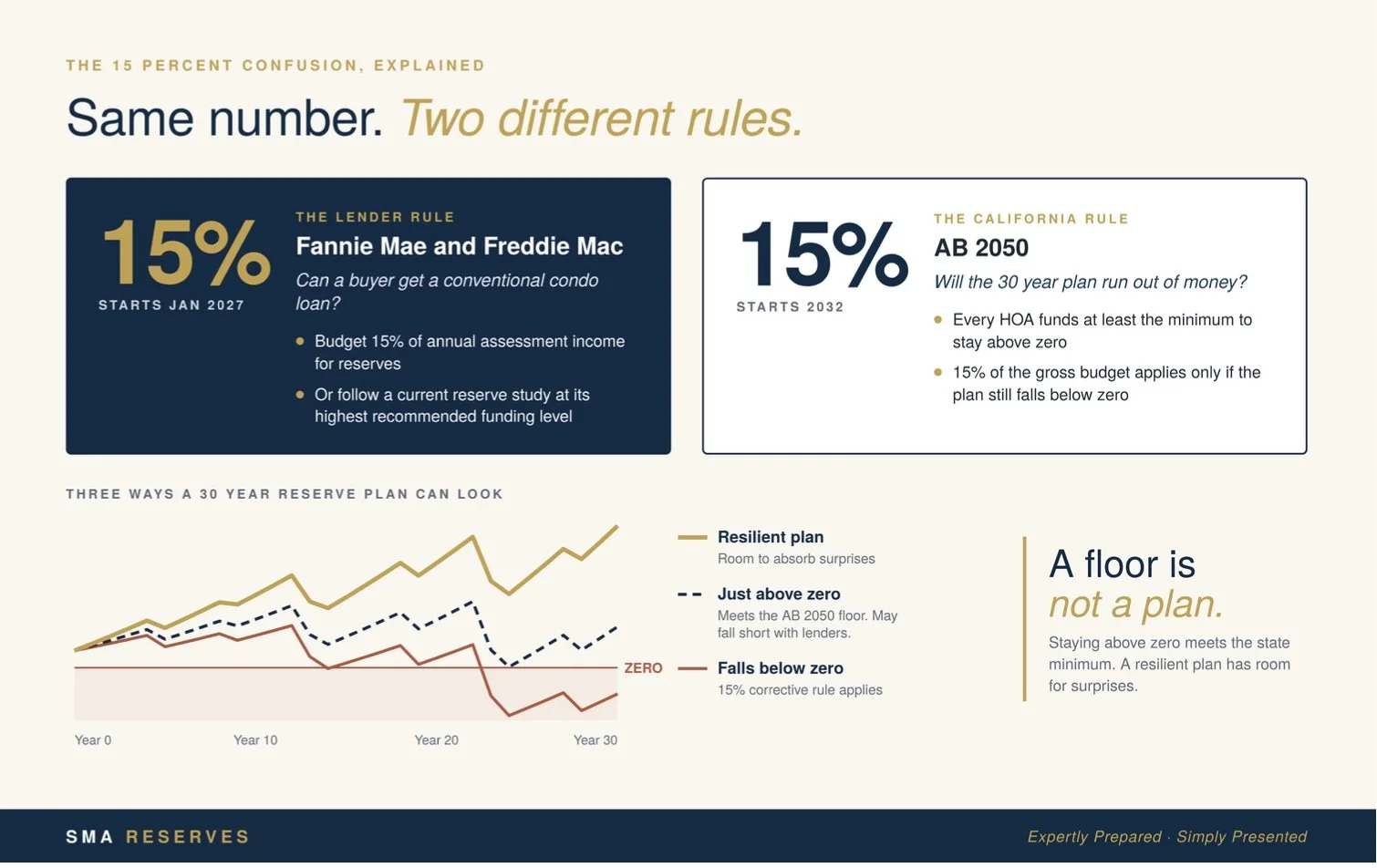
Fannie Mae and Freddie Mac buy most conventional mortgages from lenders, so their rules decide whether a buyer can get a normal loan on a condo. For loan applications dated on or after January 4, 2027, they expect a condominium budget to put at least 15 percent of its regular assessment income into reserves. The old standard was 10 percent.
For Sample Condos, the target moves from $100,000 to $150,000. At $130,000, it used to pass. In January, it will not.
The reserve study option
There is a second way through, and this is where people get confused. Instead of meeting the 15 percent test, the association can rely on a reserve study completed within the last three years. But since August 3, 2026, the budget must fund the study's highest recommended contribution. A baseline plan, one that only keeps the balance above zero, no longer counts.
So what is the highest recommended number? Many studies show more than one funding plan. One might be a minimum that just stays above zero. One is the preparer's recommendati
on. Some reports add a stronger option or a few what if scenarios. The lender looks for the largest amount the preparer actually recommends. For Sample Condos, that is $175,000. The $120,000 minimum does not qualify, even though it appears in the study.
Here is the gray area. If a report calls two or three plans "recommended," a lender may expect the association to fund the highest one. If Sample Condos also had a $225,000 plan described as a recommendation, that could become the bar. So the wording in a reserve study now matters. The report should name one recommended contribution clearly and label everything else as an option or a scenario.
This applies to condominium projects, not every HOA, and missing it does not mean the association broke a law. It means buyers may have trouble getting a conventional loan, and fewer buyers usually means longer sales for every owner.
The California rule comes later
AB 2050 was signed in September, and its funding requirements begin in 2032. It asks a simpler question. Will the 30 year reserve plan run out of money?
Starting in 2032, every reserve study must calculate the minimum annual contribution needed to keep the projected balance above zero for the next 30 years, and the associ
ation must fund at least that amount. Only if the projecti on still falls below zero does 15 percent come in. Then the association must put at least 15 percent of its gross annual budget into reserves each year until the projection is back above zero. If that still is not enough, the law sets out a special assessment process.
Using today's numbers for simplicity, Sample Condos at $130,000 is above its $120,000 minimum.
It meets the state's floor.
Where the two rules meet
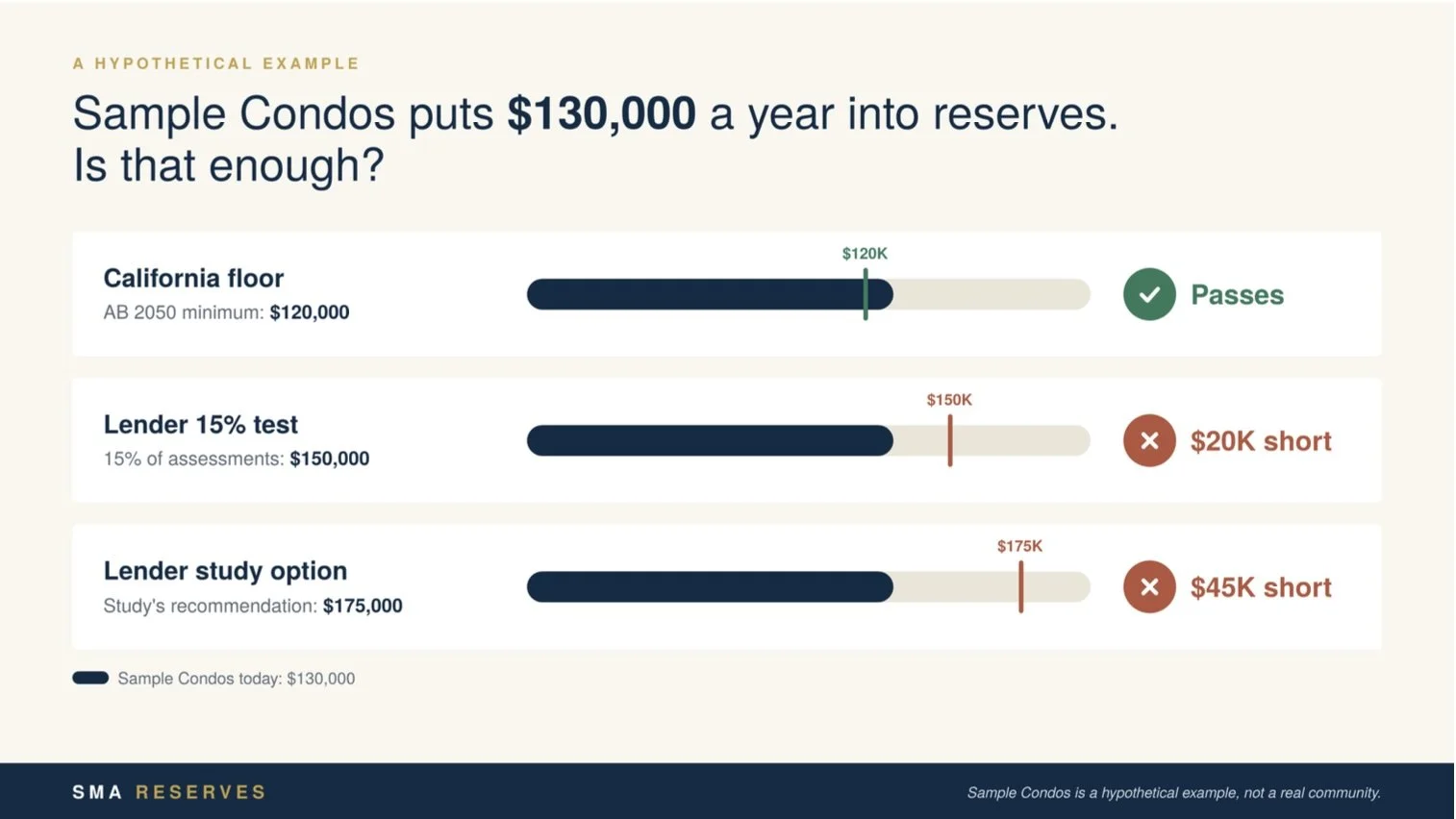
Put them side by side and the problem shows up. At $130,000, Sample Condos meets AB 2050 and still falls short with a lender, who wants $150,000 or the study's $175,000.
That is why I keep saying a floor is not a plan. A checking account with one dollar in it is technically above zero, but nobody would call that ready to replace the roof. Roofs, paving, plumbing and balconies do not politely take turns. Costs rise, projects show up early, and sometimes three large projects land in the same five year window.
What boards can do now
The good news is time. Start with a current study that includes everything the association maintains, including the shared gas, water and electrical lines AB 2050 calls out. Know your three numbers: what it takes to stay above zero, what the study recommends, and what 15 percent of your regular assessments would be. Then start talking with homeowners early. Act early and you get a staircase. Wait, and you may be left with a ladder that goes straight up.
If you are not sure where your association lands, we can show you. SMA Reserves will lay out those three numbers side by side, so your board can see the gap and plan for it with confidence.
Staying above zero is the minimum. A resilient plan is the goal.
Sample Condos is a hypothetical example. This article is general education, not legal advice. Associations should consult qualified counsel about how these rules apply to their own situation.
